


Introduction
AC motors are widely used in industrial automation, pumps, fans, compressors, conveyors, and a wide range of OEM equipment. Although AC motors are known for reliability, long-term operation under harsh industrial conditions inevitably leads to performance issues. Understanding common AC motor problems and how to diagnose them correctly is critical for minimizing downtime, reducing maintenance costs, and extending motor service life.
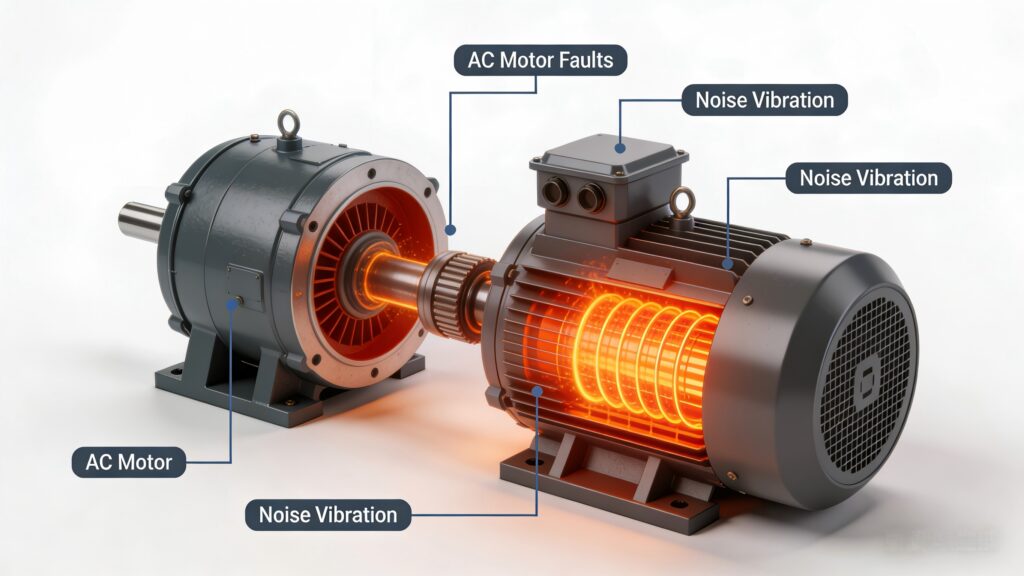
Among all failure cases, four issues account for the majority of AC motor faults: abnormal noise, excessive vibration, overheating, and low torque. These problems are often interconnected and may originate from mechanical defects, electrical imbalance, improper installation, or incorrect motor selection. This guide provides a practical, engineering-oriented approach to AC motor troubleshooting, suitable for both on-site technicians and OEM design engineers.
1.AC Motor Noise: Causes and Diagnosis
Typical Types of AC Motor Noise
Abnormal AC motor noise is often the earliest sign of failure. Common noise patterns include:
- Grinding or scraping sounds
- Humming or buzzing
- Whining at high speed
- Knocking or rattling
Common Causes of AC Motor Noise
Mechanical causes:
- Bearing wear or insufficient lubrication
- Misalignment between motor shaft and load
- Loose mounting bolts or motor base
- Cooling fan damage or imbalance
Electrical causes:
- Voltage imbalance between phases
- Magnetic saturation of the stator core
- Harmonic interference from variable frequency drives (VFDs)
How to Diagnose AC Motor Noise
- Run the motor without load to determine whether noise is load-related.
- Inspect bearings for wear, contamination, or lubrication failure.
- Check mounting bolts, fan cover, and coupling alignment.
- Measure supply voltage balance and VFD parameters.
Early identification of AC motor noise helps prevent secondary damage such as bearing seizure or rotor-stator contact.
2.AC Motor Vibration: Root Causes and Troubleshooting
Why AC Motor Vibration Is Critical
Excessive AC motor vibration accelerates bearing fatigue, loosens fasteners, and reduces insulation life. Persistent vibration is a major contributor to premature motor failure in industrial environments.
Common Causes of AC Motor Vibration
- Rotor imbalance or eccentricity
- Shaft misalignment
- Worn or improperly installed bearings
- Uneven motor foundation or soft foot condition
- Electrical imbalance causing uneven magnetic pull
AC Motor Vibration Diagnosis Steps
- Verify mechanical installation and base flatness.
- Check shaft alignment using dial indicators or laser tools.
- Measure vibration frequency to distinguish imbalance from bearing defects.
- Inspect power supply for voltage and current imbalance.
Engineering Prevention Measures
Precision rotor balancing, strict bearing tolerance control, and reinforced motor housings significantly reduce vibration risk during long-term operation.
3.AC Motor Overheating: Causes and Engineering Solutions
Why AC Motor Overheating Occurs
AC motor overheating is one of the most common and destructive motor problems. Excessive temperature shortens insulation life and can lead to winding failure.
Common Causes of AC Motor Overheating
- Overloading beyond rated capacity
- Inadequate ventilation or blocked cooling paths
- High ambient temperature
- Voltage imbalance or incorrect frequency
- Frequent starts and stops exceeding duty cycle limits
How to Diagnose AC Motor Overheating
- Measure operating current and compare with rated current.
- Check cooling fan condition and airflow paths.
- Monitor winding temperature using thermal sensors.
- Verify power supply voltage and frequency stability.
Design-Level Solutions
Selecting appropriate insulation class, optimizing cooling design, and matching motor rating to application load are essential for preventing overheating in OEM equipment.
4.AC Motor Low Torque: Diagnosis and Selection Tips
Understanding Low Torque Issues
Low torque in AC motors often leads to startup failures, unstable speed, and repeated overheating. This issue is particularly critical in pumps, conveyors, and compressors.
Common Causes of AC Motor Low Torque
- Incorrect motor selection for load characteristics
- Insufficient starting torque
- Voltage drop during startup
- Rotor defects or winding damage
How to Diagnose Low Torque in AC Motors
- Measure starting current and acceleration time.
- Compare motor torque curve with application requirements.
- Inspect rotor condition and electrical connections.
- Verify power supply capacity during startup.
OEM Selection Advice
When designing equipment, motor selection should consider torque characteristics rather than rated power alone. Proper matching ensures stable operation and long service life.
Conclusion: A Systematic Approach to AC Motor Troubleshooting
Common AC motor problems such as noise, vibration, overheating, and low torque are rarely isolated events. A systematic diagnostic approach that considers mechanical, electrical, and application-level factors is essential for accurate fault identification.
For OEMs and industrial users, investing in proper motor selection, precision manufacturing, and preventive maintenance significantly reduces failure rates and improves overall system reliability. By understanding how to diagnose AC motor problems correctly, engineers can ensure long-term performance and operational stability.
FAQ
What are the most common AC motor problems?
The most common AC motor problems include abnormal noise, excessive vibration, overheating, and insufficient torque.
How do you diagnose AC motor vibration?
Diagnosis involves checking installation alignment, bearing condition, rotor balance, and power supply stability.
Can low torque damage an AC motor?
Yes. Low torque can cause prolonged startup, overheating, and increased mechanical stress, leading to premature failure.
Is AC motor noise always a mechanical problem?
No. AC motor noise can originate from both mechanical issues and electrical factors such as voltage imbalance or magnetic saturation.
For OEM projects or motor selection support, consult with our engineering team.