


- Home
- Product
- GOST standard motor
- IEC standard motor
 MC Series single phase capacitor start asynchronous motor
- MY MYT series single phase capacitor running asynchronous motor
- ML Series single phase dual-capacitor asynchronous motor
- ME2 series three phase high efficiency aluminum housing motor(IE2)
- ME3 series three phase high efficiency aluminum housing motor(IE3)
- MS series three-phase aluminum housing motor (IE1)
- Y2 series three phase cast iron motor (IE1)
- YE2 series three phase high efficiency cast iron motor (IE2)
- YE3 series three phase high efficiency cast iron motor (IE3)
- Special application motor
- Rolling door motor
- Industry application
- News
- About us
- Contact us
- Certifications
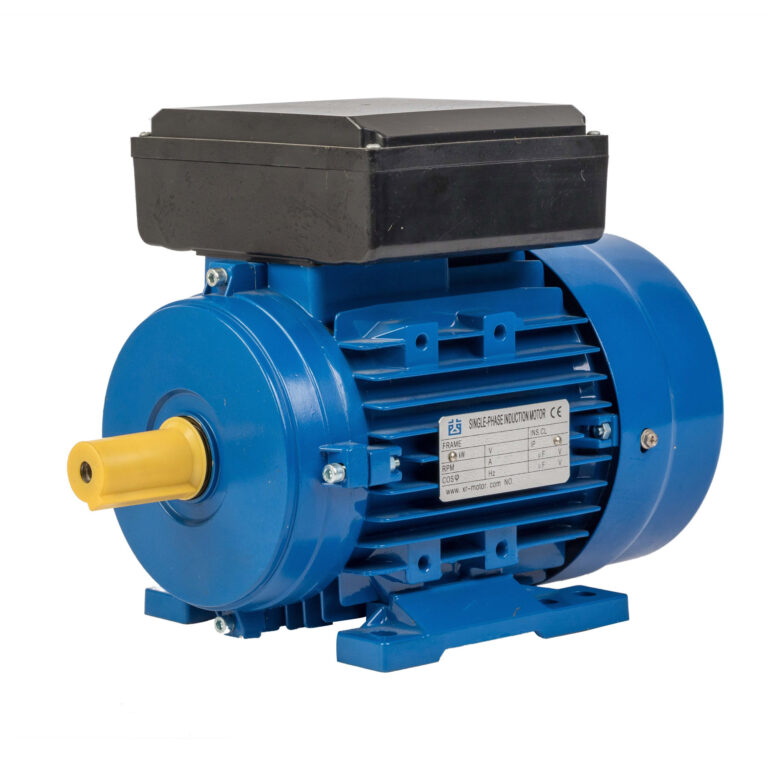
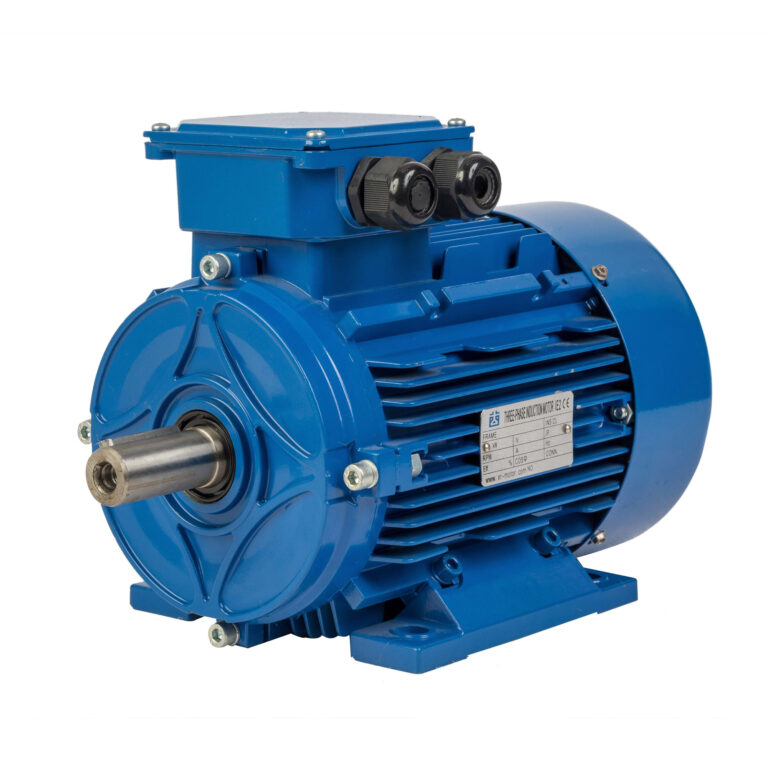
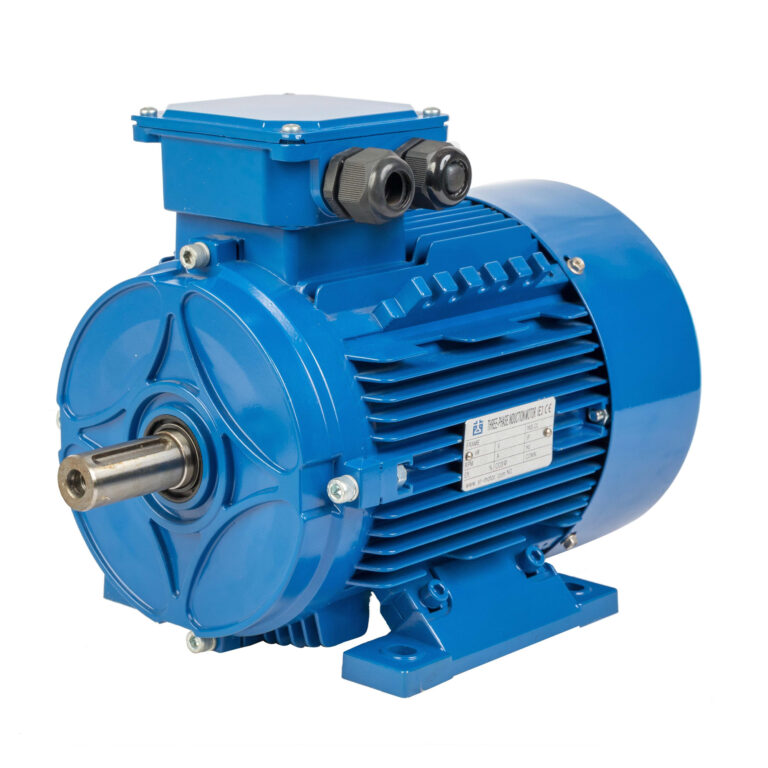
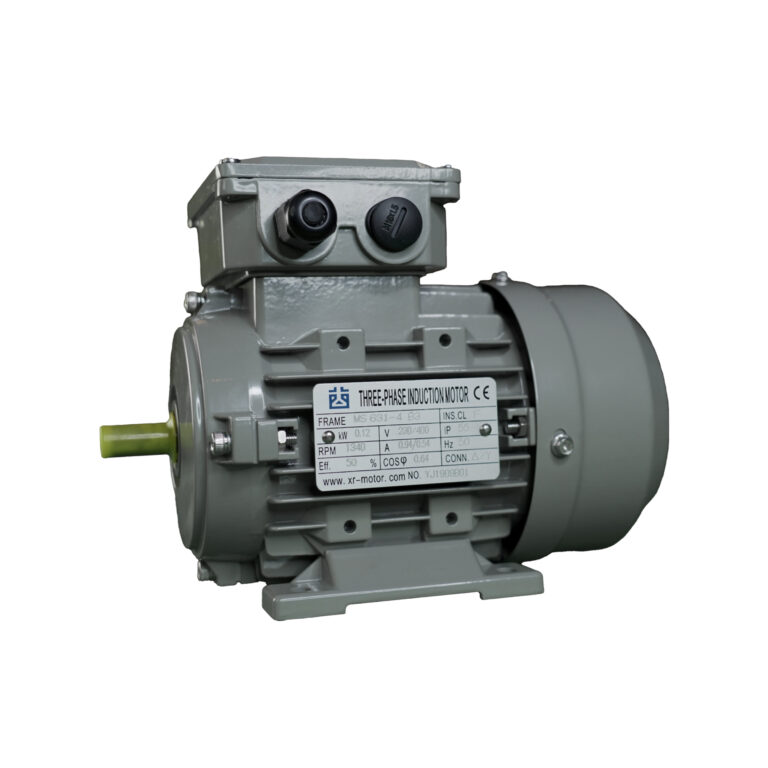
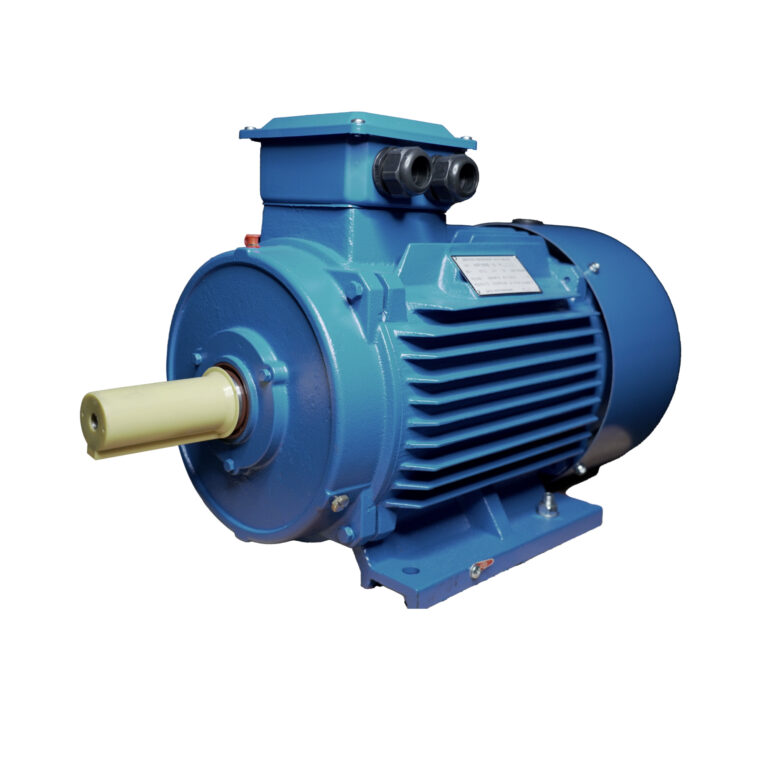
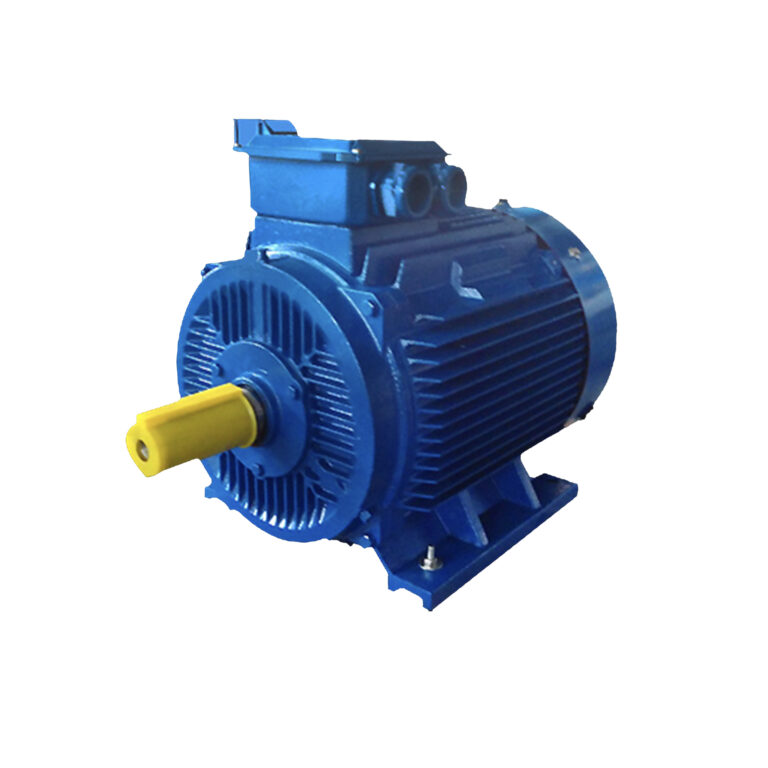
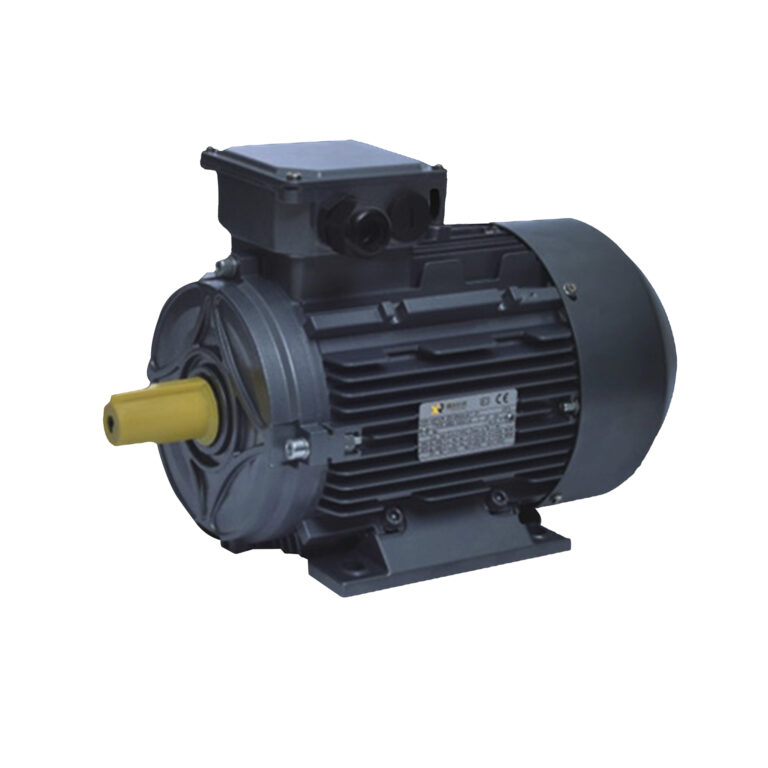
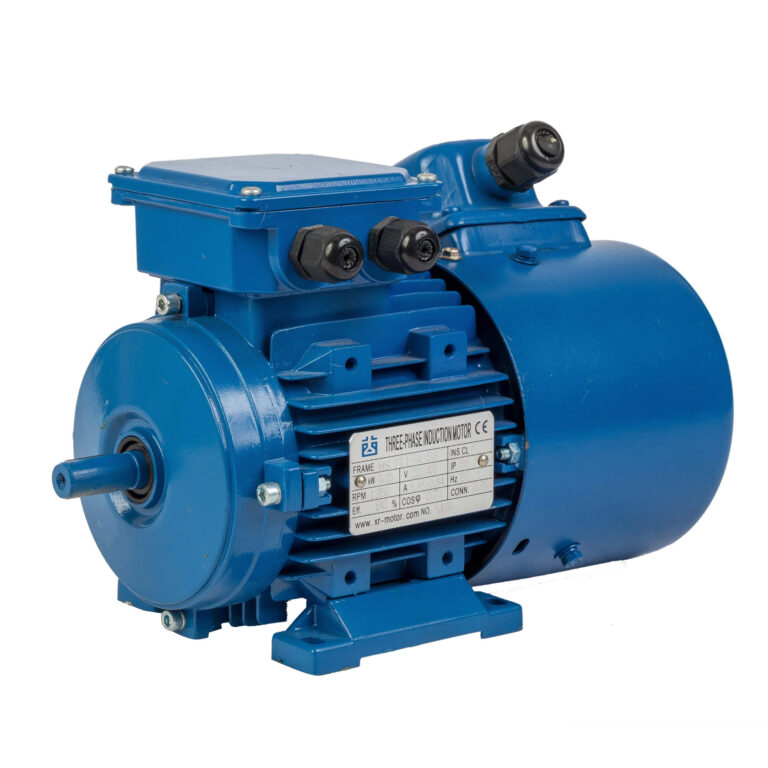
How to Choose an Electric Motor for Industrial Pumps
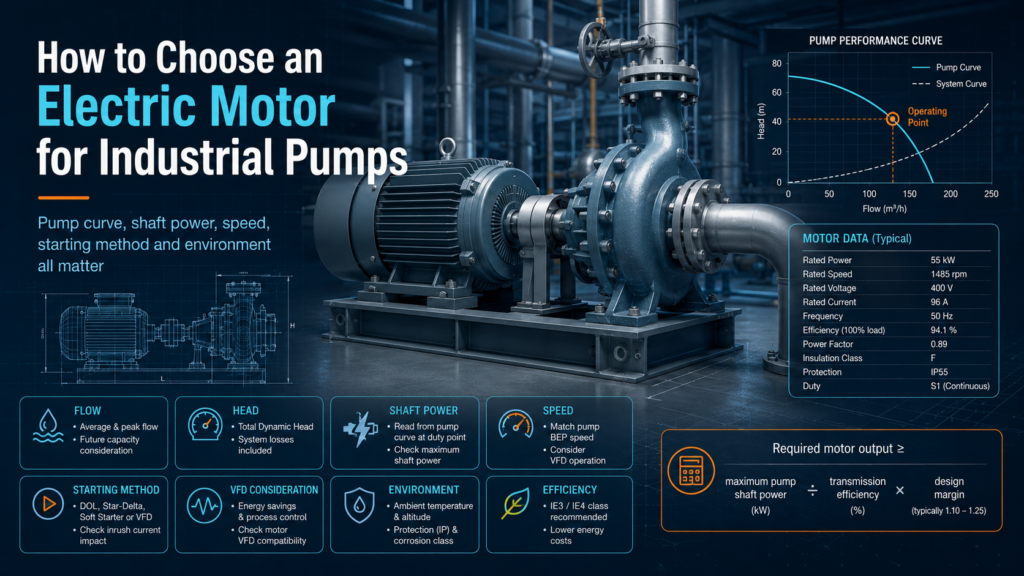
Choosing the right electric motor for pump duty starts with the pump, not the motor catalog. Flow, head, fluid properties, operating point, starting method, and site conditions must be understood before the motor power is selected.
A motor that is too small may overload and overheat, while an oversized motor can increase purchase cost and spend much of its life running inefficiently. DAYOU MOTOR therefore recommends selecting from the pump’s maximum expected shaft power rather than relying only on the power shown at the design point.
Good Electric Motor Pump Selection Starts with the Operating Point
Reliable electric motor pump selection requires the pump curve and the expected system conditions. Ask the pump supplier for rated flow, head, efficiency, shaft power, and the permitted operating range.
The fluid also matters. Density, viscosity, temperature, and solids content can change the power required by the pump. Clean water service is usually predictable, while oils, slurries, chemicals, and other viscous fluids may need additional engineering review.
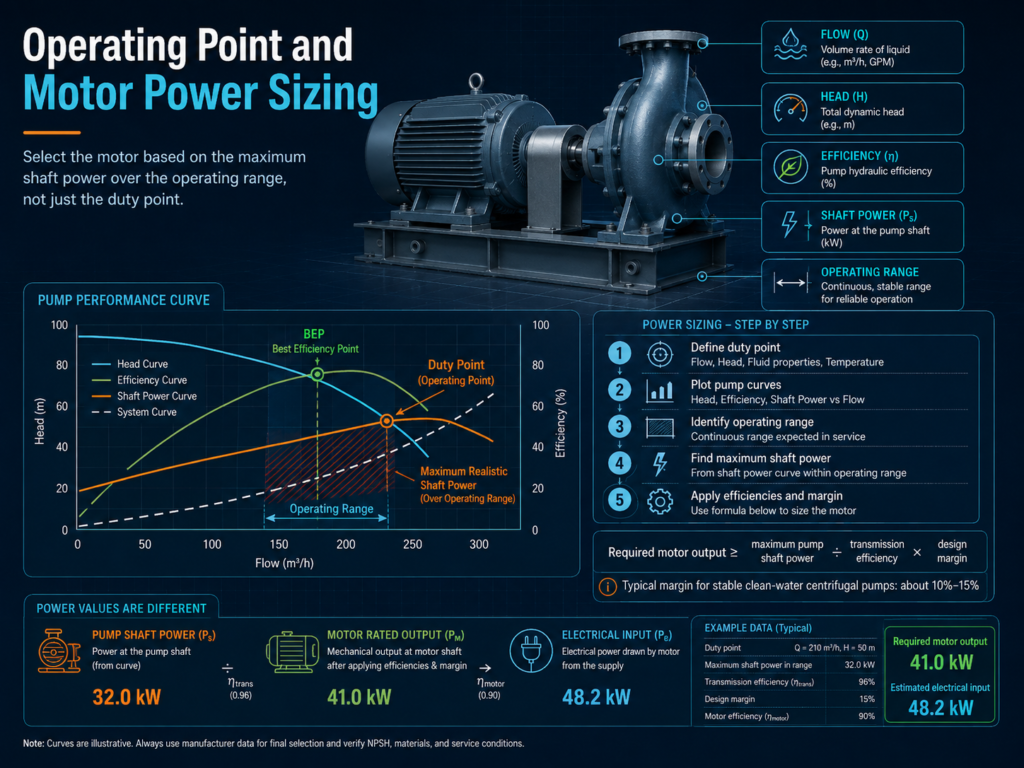
A pump does not always operate at its original design point. Valve position, pipe resistance, tank level, filter condition, and process demand can move the operating point, so the motor must cover the highest realistic shaft-power demand within the approved pump range.
Motor Power Should Cover the Worst Expected Condition
A correctly sized electric motor for pump duty should provide more mechanical output than the maximum pump shaft power. The required motor output can be estimated as:
Required motor output ≥ maximum pump shaft power ÷ transmission efficiency × design margin
Transmission losses should be included when belts, gearboxes, or other mechanical components sit between the motor and pump. With a direct coupling, losses are smaller, but alignment and coupling condition still affect performance.
The electrical input is a separate value. It can be estimated by dividing the motor’s mechanical output by motor efficiency. Keeping these two calculations separate prevents confusion between pump shaft power, motor rated output, and electricity consumption.
A margin of around 10%–15% may be reasonable for some stable clean-water centrifugal applications, although it should not be treated as a universal rule. Viscous fluids, changing operating points, frequent starts, uncertain process conditions, or high inertia may justify a different margin.
Speed and Pole Number Must Match the Pump Curve
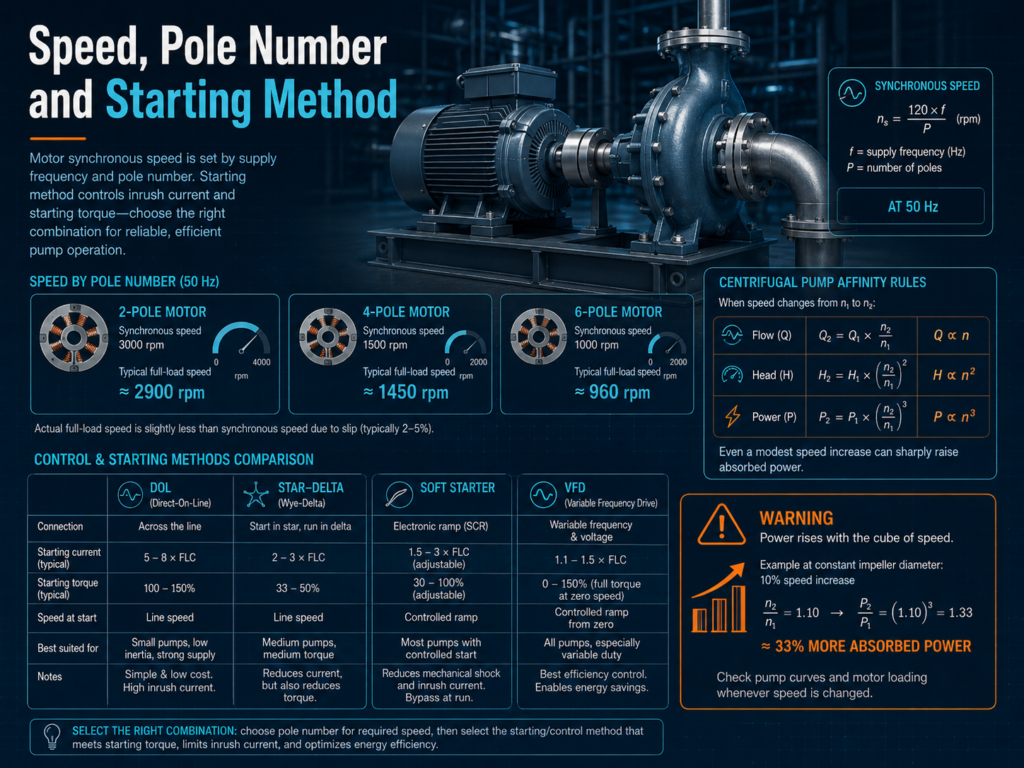
Speed matters because an electric motor for pump service must operate close to the speed used to generate the pump curve. At 50 Hz, typical full-load speeds are approximately 2,900 rpm for a 2-pole motor, 1,450 rpm for a 4-pole motor, and 960 rpm for a 6-pole motor.
Using the wrong speed can change flow, head, power demand, and suction conditions. For a centrifugal pump with the same impeller diameter, flow varies approximately with speed, head with the square of speed, and power with the cube of speed, subject to the limitations of the affinity rules.
This relationship explains why even a modest speed increase can create a much larger rise in absorbed power. Always compare the selected motor’s actual rated speed with the pump manufacturer’s curve.
A pump motor for European OEMs should also be checked against the project’s 50 Hz or 60 Hz supply, because changing frequency without reviewing voltage, speed, and pump performance can produce an unsuitable operating point.
Starting Method Depends on the Pump and the Power Supply
Direct-on-line starting is simple, but its starting current can place stress on the electrical network. Larger motors or sites with limited grid capacity may require star-delta starting, a soft starter, or a variable-frequency drive.
The pump condition during startup also matters. A centrifugal pump may start under different valve conditions, while positive-displacement and screw pumps can require substantial starting torque. Check acceleration time, load inertia, available voltage, and the number of starts per hour before selecting the control method.
A three phase motor for pump applications in Southeast Asia may need to support local voltage combinations, humidity conditions, and VFD operation. These requirements should be written into the RFQ instead of being confirmed after production.
Centrifugal and Positive-Displacement Pumps Need Different Torque
Centrifugal pumps generally behave as variable-torque loads. When their speed is reduced with a VFD, the required torque and power usually fall, which can provide useful energy savings in systems with changing flow demand.
Positive-displacement, screw, and some metering pumps operate closer to constant-torque loads. Low-speed torque, starting performance, and overload capacity are therefore more important.
When sourcing a motor for centrifugal pump systems in South America, buyers should provide the expected speed range and pump curve, while applications involving viscous fluids should include fluid data and starting conditions.
VFD Operation Requires More Than Inverter Compatibility
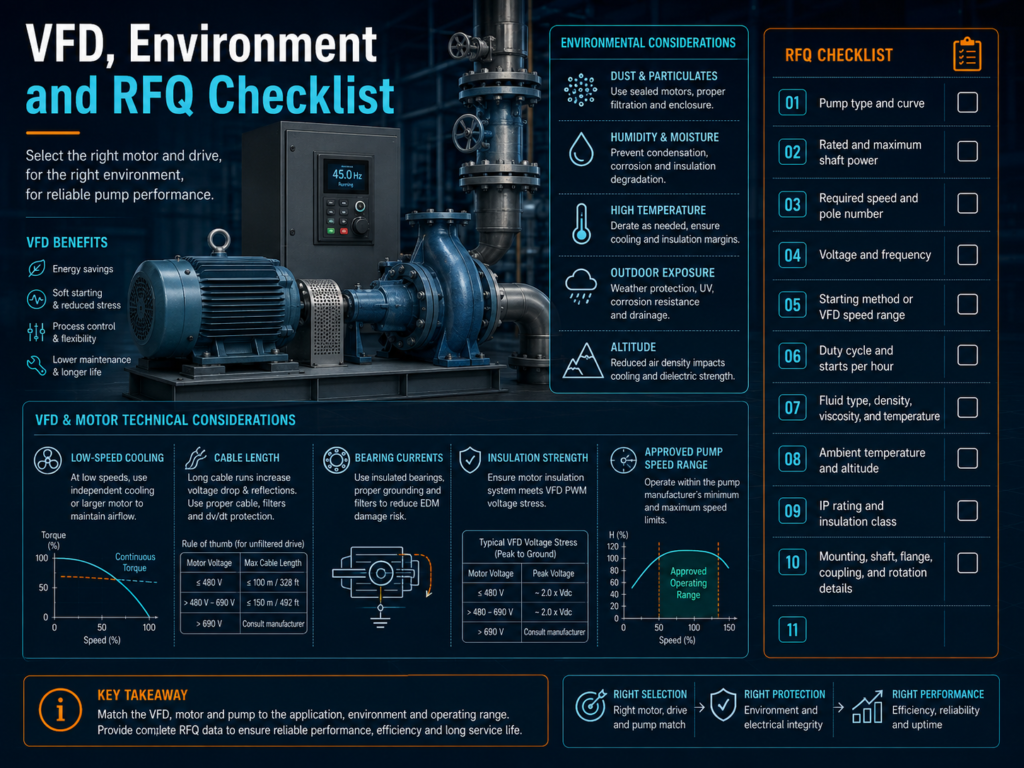
A VFD can improve control and reduce energy consumption, but the motor must remain adequately cooled throughout the speed range. Standard shaft-mounted fans produce less airflow at low speed, so continuous low-speed operation may require an independently powered cooling fan.
Cable length, inverter switching, insulation strength, bearing currents, minimum pump speed, and resonance should also be reviewed. A VFD should not be used to operate the pump outside the range approved by the pump manufacturer.
Environment and Installation Affect Reliability
An electric motor for pump duty may require additional protection in outdoor, wet, dusty, corrosive, high-temperature, high-altitude, or hazardous environments. The RFQ should define the required IP rating, insulation class, ambient temperature, corrosion protection, cooling method, and explosion-protection requirements where applicable.
An industrial pump motor supplier for Middle East projects should pay particular attention to heat, dust, ventilation, and outdoor exposure. Protection ratings alone are not enough if cooling air is restricted or the selected motor is not rated for the actual ambient temperature.
Mechanical details are equally important. Confirm voltage, frequency, mounting type, frame size, shaft diameter, flange dimensions, rotation direction, coupling design, and alignment tolerances before ordering.
Efficiency Should Be Evaluated Over the Operating Life
An IE3 motor for water pump service can reduce lifetime electricity costs when the equipment runs for long hours, although the actual benefit depends on motor loading, pump efficiency, control method, and annual operating time.
IEC 60034-30-1:2025 defines IE efficiency classes for line-operated AC motors within its stated scope, but the IE class describes the motor rather than the efficiency of the complete pumping system.
A high-efficiency motor cannot compensate for an oversized pump, throttled system, incorrect impeller, or poor operating point. Motor and pump efficiency should therefore be evaluated together.
Buyers Should Include These Details in the RFQ
When reviewing an electric motor for pump manufacturer in China, provide the following information:
- Pump type, model, and performance curve
- Rated and maximum shaft power
- Required speed and pole number
- Voltage, frequency, and connection
- Starting method or VFD speed range
- Duty cycle and starts per hour
- Fluid type, density, viscosity, and temperature
- Ambient temperature, altitude, and installation environment
- IP rating, insulation class, and efficiency requirement
- Mounting, shaft, flange, coupling, and rotation details
DAYOU MOTOR uses this application information to help customers compare motor power, starting performance, efficiency, protection, and mechanical compatibility before production.
Frequently Asked Questions
Should I choose the next much larger motor?
Not automatically. The motor should cover the maximum expected shaft power with an appropriate engineering margin, but excessive oversizing can increase cost and reduce efficiency at light load.
Can I select the motor from the rated flow and head alone?
No. Use the pump performance curve and check shaft power across the expected operating range, including the most demanding realistic condition.
Is a VFD always the best choice for a centrifugal pump?
A VFD is useful when flow demand changes, but savings depend on the system curve, operating profile, minimum speed, and control strategy. A pump that runs continuously at full speed may gain little from speed control.
The Pump Curve Should Lead the Final Decision
The best electric motor for pump duty is the one that covers the maximum realistic shaft power, matches pump speed, starts the load reliably, and survives the actual environment without being unnecessarily oversized.
DAYOU MOTOR supports pump manufacturers, equipment builders, distributors, and project buyers with application-based selection, helping each drive system achieve reliable operation and lower lifetime cost.