


- Home
- Product
- GOST standard motor
- IEC standard motor
 MC Series single phase capacitor start asynchronous motor
- MY MYT series single phase capacitor running asynchronous motor
- ML Series single phase dual-capacitor asynchronous motor
- ME2 series three phase high efficiency aluminum housing motor(IE2)
- ME3 series three phase high efficiency aluminum housing motor(IE3)
- MS series three-phase aluminum housing motor (IE1)
- Y2 series three phase cast iron motor (IE1)
- YE2 series three phase high efficiency cast iron motor (IE2)
- YE3 series three phase high efficiency cast iron motor (IE3)
- Special application motor
- Rolling door motor
- Industry application
- News
- About us
- Contact us
- Certifications
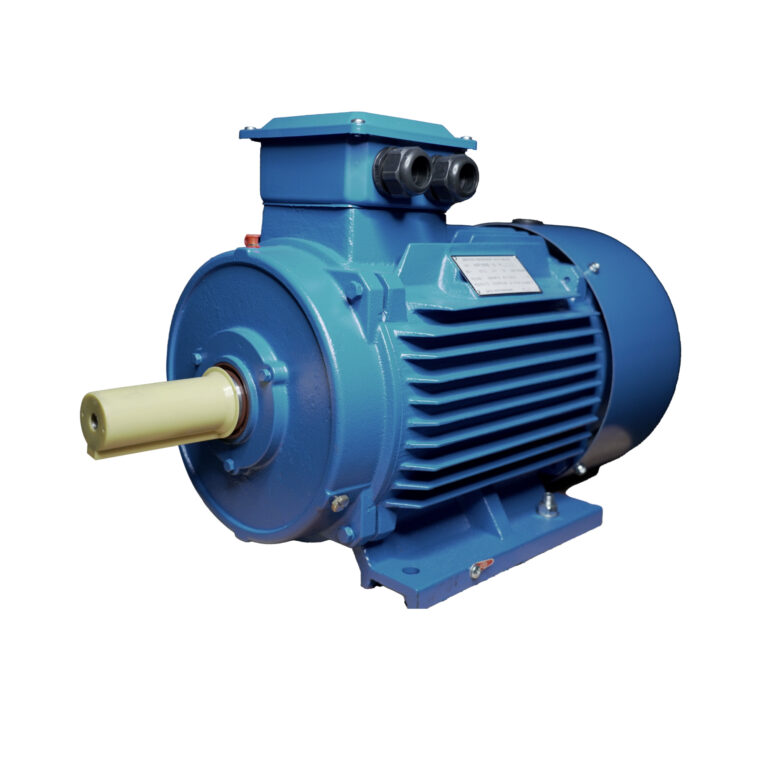
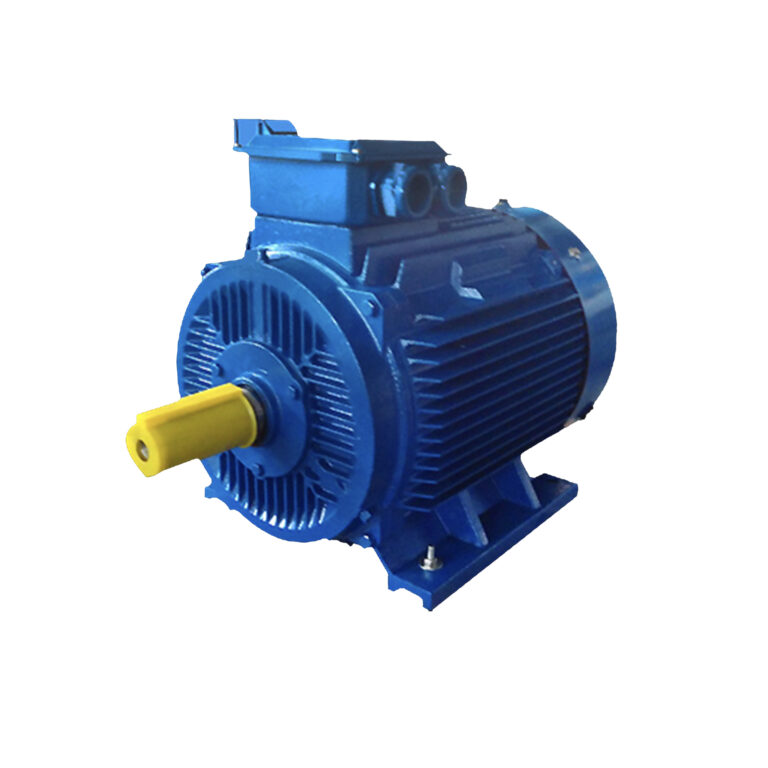
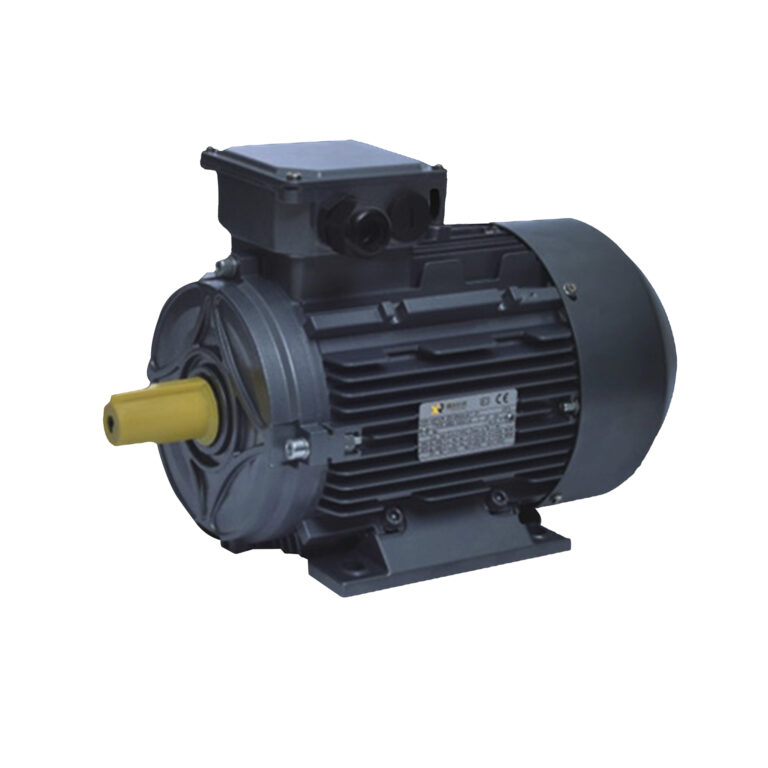
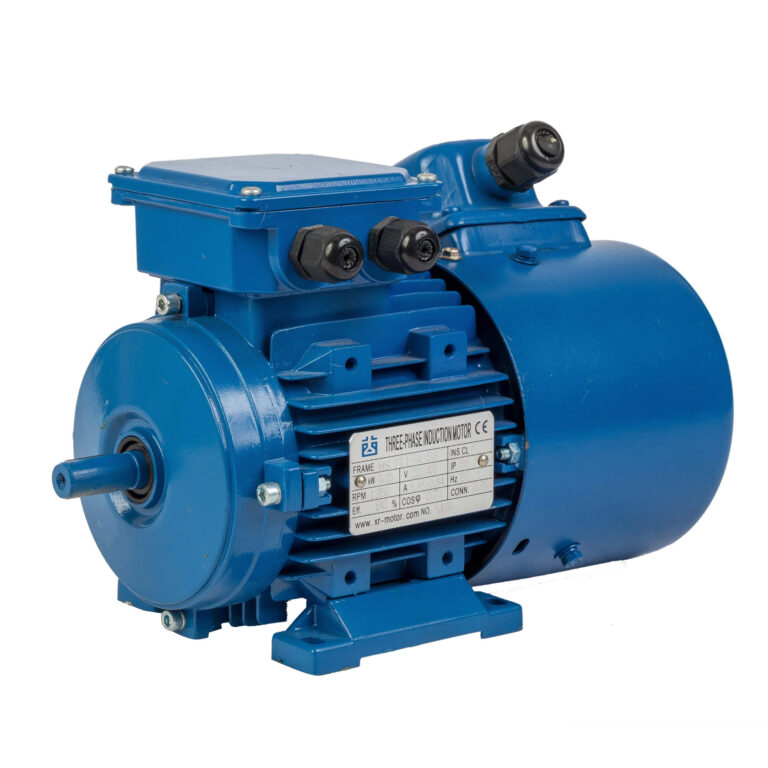
IE3 Electric Motor Supplier: What OEM Buyers Should Check
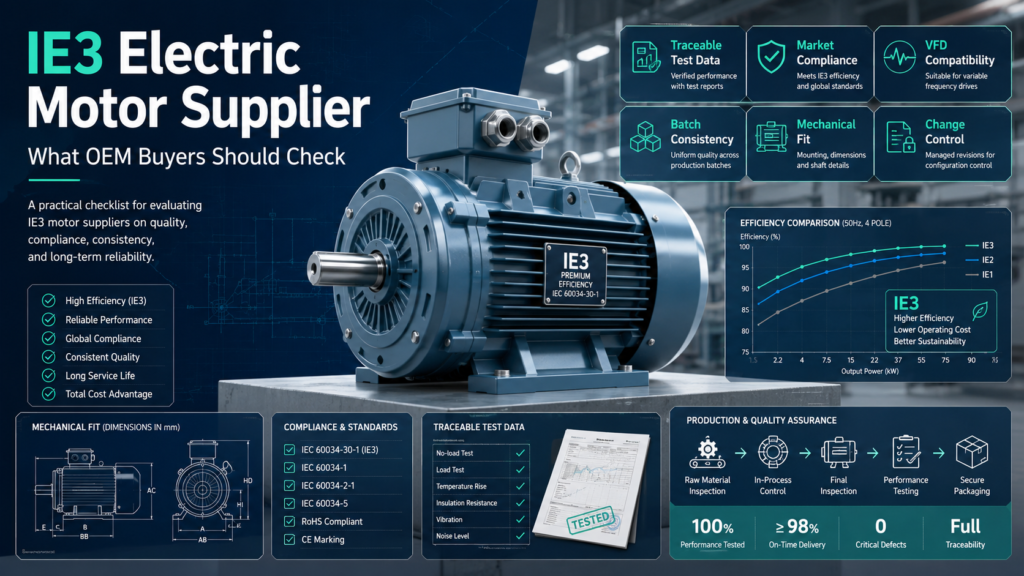
Choosing an IE3 electric motor supplier involves much more than confirming an efficiency value on a nameplate. IE3 compliance may qualify a manufacturer for consideration, but it does not prove that the motor will fit the equipment, survive the application, or remain consistent across thousands of units.
OEM buyers need evidence that the tested performance can be reproduced in normal production. DAYOU MOTOR recommends reviewing compliance, engineering capability, quality control, supply stability, and after-sales responsibility before comparing the final price.
IE3 Should Be Supported by Traceable Test Data
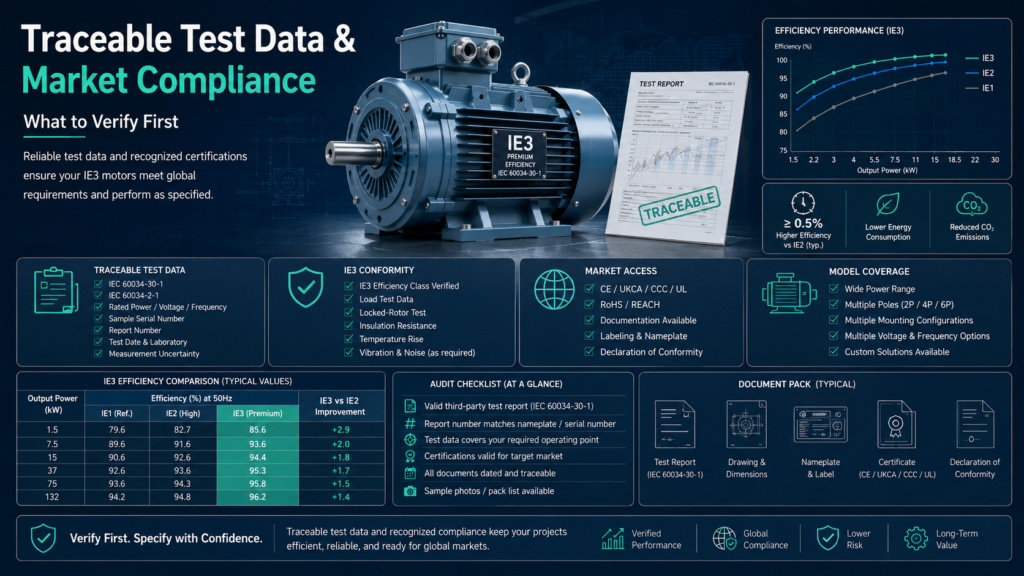
IEC publishes efficiency classifications and test methods, but the IEC itself does not certify individual motors. Buyers should therefore ask for an efficiency test report or other conformity evidence that can be traced to the quoted model.
A credible IE3 electric motor supplier should provide a report showing:
- Rated power, voltage, frequency, pole number, and duty
- Tested efficiency and applicable efficiency class
- Test method and standard edition
- Sample model and serial number
- Laboratory or testing organization
- Test date and report number
- Relationship between the tested sample and production models
- Measurement uncertainty or applicable tolerance information
IEC 60034-30-1:2025 defines efficiency classes for qualifying line-operated AC motors, while IEC 60034-2-1:2024 establishes standard methods for determining losses and efficiency from tests.
A report for one motor should not automatically be assumed to cover every frame, voltage, pole configuration, or customized version in the product family. The supplier should explain the technical basis for any claimed coverage.
Market Compliance Must Be Checked Separately
An IE3 classification does not automatically satisfy every country’s legal requirements. Product scope, rated power, pole number, duty, supply, and special construction can affect which rules apply.
For China, GB 18613-2020 remains listed as the current mandatory national standard for minimum allowable motor efficiency and efficiency grades.An IE3 motor manufacturer for European OEMs should also understand that IE3 is not sufficient for every EU application. In-scope motors between 75 kW and 200 kW have been required to meet IE4 since July 2023, although the regulation’s complete scope and exclusions must still be reviewed for each product. CE, UKCA, UL, CSA, CCC, or other market-access documents should likewise be checked against the exact model and destination rather than accepted as general company-level claims.
Equipment Fit Matters as Much as Rated Efficiency
A high-efficiency design is not automatically suitable for the OEM’s machine. The RFQ should define:
- Load type and required torque curve
- Starting torque and permitted starting current
- Continuous, intermittent, or frequent-start duty
- Voltage, frequency, and allowable variation
- Ambient temperature, altitude, humidity, dust, and corrosion
- IP rating, insulation system, and temperature-rise limits
- Horizontal or vertical installation
- Frame, shaft, flange, and terminal-box arrangement
- Noise, vibration, and bearing-life targets
- VFD model and operating-speed range
An IE3 three phase motor may have different dimensions, weight, starting behavior, or thermal characteristics from the lower-efficiency unit it replaces. Never assume interchangeability from kW and frame size alone.
For pumps, fans, compressors, and conveyors, request the relevant torque, current, efficiency, power-factor, and temperature-rise data. Part-load performance is particularly important when the machine rarely operates at full output.
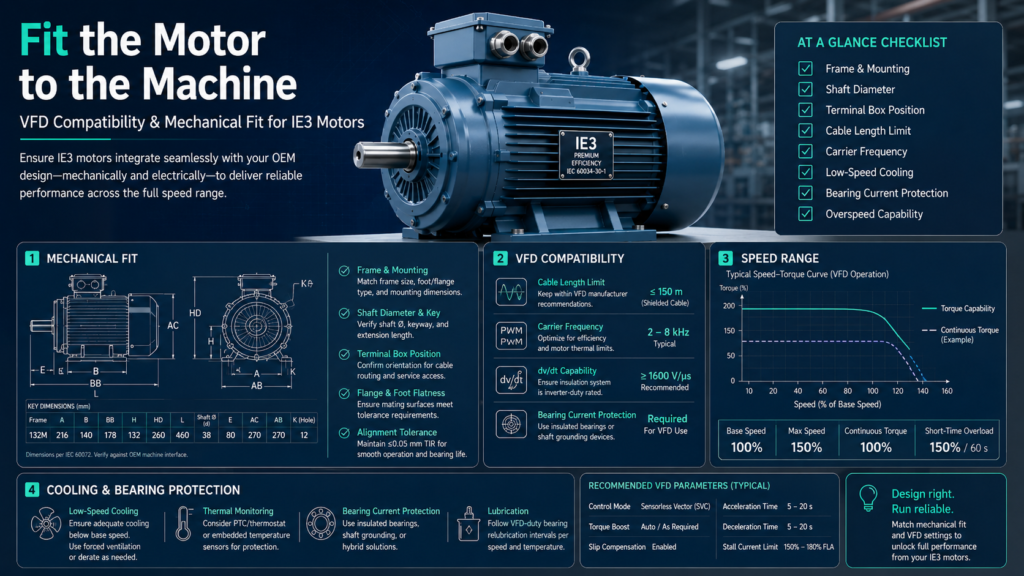
VFD Operation Needs Separate Verification
A mains-supply efficiency report does not fully describe performance under converter operation. PWM voltage, switching frequency, cable length, filters, and VFD settings can create additional losses and electrical stress.
IEC 60034-2-3:2024 provides specific methods for determining losses and efficiency in converter-fed AC motors, including standardized operating points across the torque and speed range. It also notes that standardized comparison testing does not necessarily represent losses with every final converter and cable combination. OEM buyers should confirm:
- Permitted frequency and speed range
- Low-speed cooling requirements
- Insulation resistance to converter voltage peaks
- Maximum cable length
- Carrier-frequency limits
- Overspeed capability
- Bearing-current protection
- Output-filter requirements
A statement such as “VFD compatible” is incomplete unless these operating boundaries are documented.
Sample Performance Must Continue in Volume Production
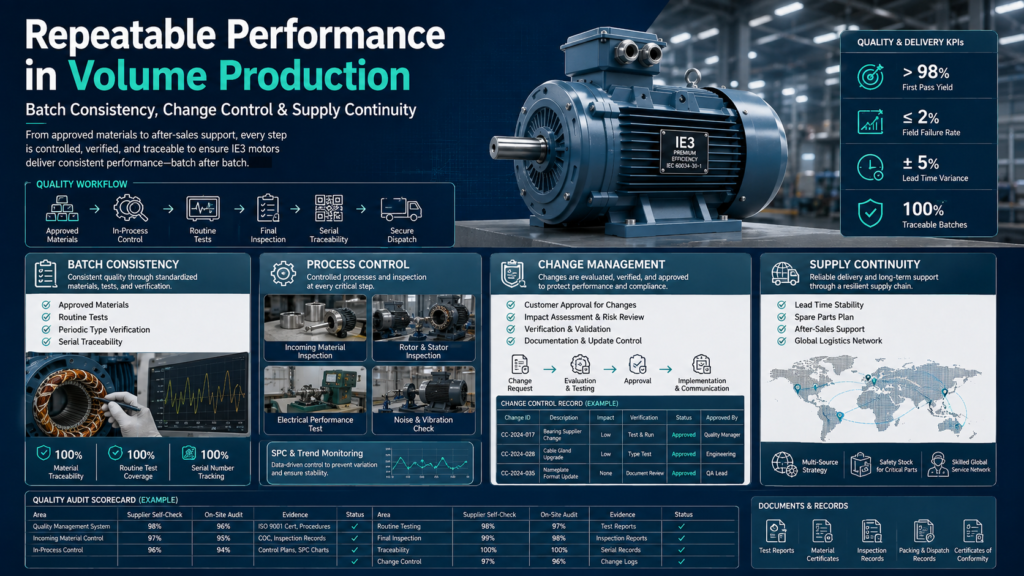
For an IE3 electric motor supplier, producing one qualified sample is only the beginning. The greater challenge is maintaining efficiency, temperature rise, vibration, and mechanical performance across repeated production batches.
Factory audits should examine winding, rotor, lamination, machining, impregnation, balancing, and assembly processes. Copper wire, electrical steel, bearings, insulation materials, and cooling components should have controlled specifications and approved sources.
Routine tests such as insulation resistance, dielectric withstand, no-load current, vibration, and noise may be performed on every unit. Efficiency and temperature rise are more commonly controlled through type testing, periodic sampling, or agreed audit tests.
DAYOU MOTOR recommends placing first-article approval, production sampling, and periodic type verification in the quality agreement, together with clear acceptance methods.
Mechanical Interfaces Should Be Frozen Before Production
Higher-efficiency designs may not share the exact envelope or starting characteristics of an existing motor. Buyers should approve drawings that identify:
- Frame and mounting dimensions
- Shaft diameter, extension, tolerance, and keyway
- Flange dimensions and locating diameter
- Terminal-box position and cable entry
- Overall weight and lifting points
- Rotation direction
- Starting current and torque
- Accessories and sensor positions
Special shafts, encoders, brakes, heaters, temperature sensors, and custom flanges should receive a documented engineering review. Temporary workshop modifications to a standard unit are not a substitute for a controlled OEM design.
Change Management Protects Long-Term Consistency
The contract with an IE3 electric motor supplier should prohibit unapproved changes to electrical steel, copper wire, bearings, winding data, rotor design, insulation, cooling fans, or production location.
Even a seemingly minor change can affect efficiency, temperature rise, noise, vibration, or service life. The agreement should define:
- Which changes require customer approval
- How far in advance notice must be provided
- What validation is required after a change
- How affected batches will be identified
- Whether last-time purchase support is available
- How discontinued parts will be replaced
Traceability should connect the serial number to production date, material batch, test records, and nonconformance history.
Regional Buyers May Prioritize Different Evidence
A high efficiency motor supplier for Middle East projects should document performance at the specified ambient temperature, together with dust protection, cooling, and voltage conditions.
An industrial motor supplier for Southeast Asian factories may need to address humidity, condensation, regional voltage combinations, and replacement availability. An OEM electric motor supplier for North American equipment builders should understand applicable efficiency, safety, nameplate, and dimensional requirements.
An IEC motor supplier for South American distributors should also support local voltage and frequency options, export documentation, spare parts, and practical warranty communication.
Total Cost Is More Useful Than Purchase Price Alone
The lowest-priced motor does not always create the lowest OEM cost. Buyers should consider:
- Purchase price and transport
- Expected load profile and annual operating hours
- Efficiency and power factor
- VFD and control-system adaptation
- Maintenance and spare-parts costs
- Warranty coverage
- Unplanned downtime
- Redesign or installation risk
A small efficiency difference can become financially meaningful in continuous service. However, any energy saving can quickly disappear if the motor requires mechanical modification, develops bearing problems, or arrives late.
Use an Evidence-Based Supplier Checklist
Before approving an IE3 electric motor supplier, obtain evidence for each area:
Audit area | Evidence to request |
IE3 conformity | Model-specific type-test report and test standard |
Market access | Applicable declarations, certificates, and technical files |
Application fit | Selection sheet, torque curve, temperature-rise and derating data |
VFD compatibility | Speed range, insulation, cooling, bearing, and cable limits |
Batch consistency | Inspection plan, process records, and sampled results |
Critical materials | Controlled specifications and approved suppliers |
Mechanical fit | Drawings, tolerances, and sample assembly confirmation |
Traceability | Serial, batch, inspection, and nonconformance records |
Change control | Written notification and customer-approval procedure |
Supply continuity | Capacity, lead time, spare parts, and discontinuation plan |
After-sales support | Warranty, failure analysis, and corrective-action timing |
Reliable Supply Means Repeatable Performance
The right IE3 electric motor supplier does more than submit an efficiency report. It demonstrates that the tested performance can be reproduced across production batches, fitted correctly into the OEM’s equipment, and supported throughout the product lifecycle.
DAYOU MOTOR works with OEM buyers to confirm technical requirements, sample validation, quality controls, and supply expectations before volume production begins.