


- Home
- Product
- GOST standard motor
- IEC standard motor
 MC Series single phase capacitor start asynchronous motor
- MY MYT series single phase capacitor running asynchronous motor
- ML Series single phase dual-capacitor asynchronous motor
- ME2 series three phase high efficiency aluminum housing motor(IE2)
- ME3 series three phase high efficiency aluminum housing motor(IE3)
- MS series three-phase aluminum housing motor (IE1)
- Y2 series three phase cast iron motor (IE1)
- YE2 series three phase high efficiency cast iron motor (IE2)
- YE3 series three phase high efficiency cast iron motor (IE3)
- Special application motor
- Rolling door motor
- Industry application
- News
- About us
- Contact us
- Certifications
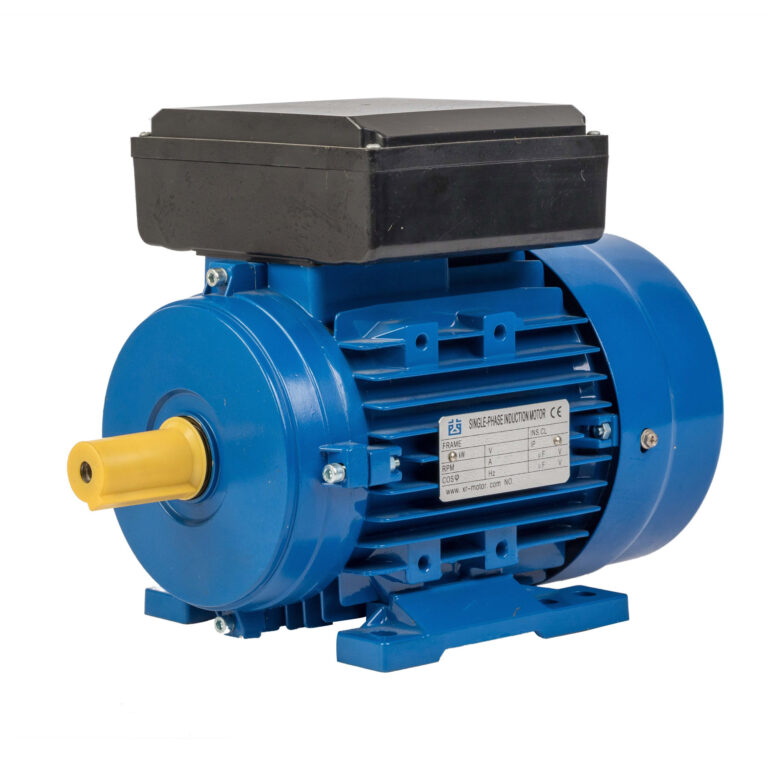
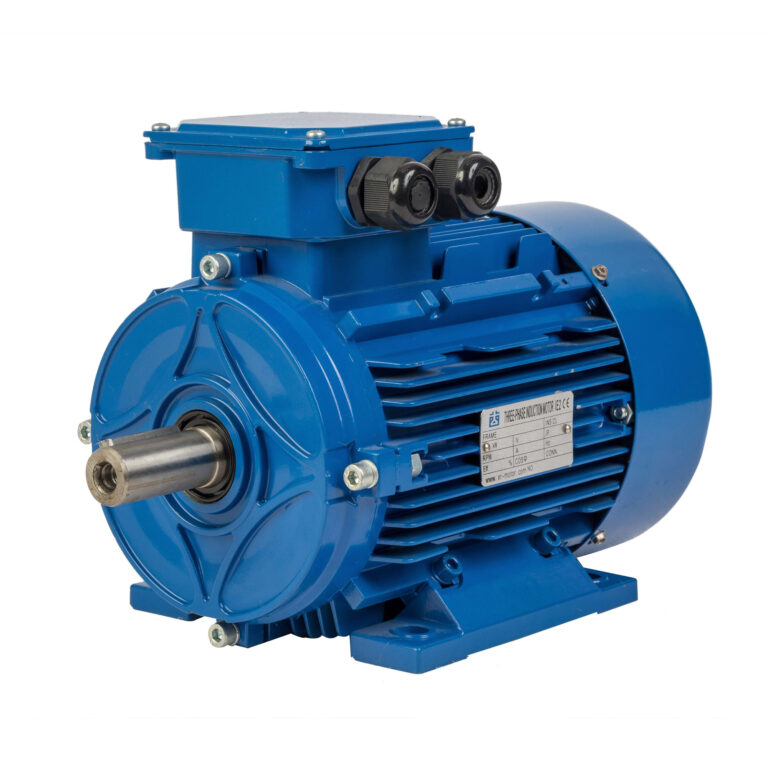
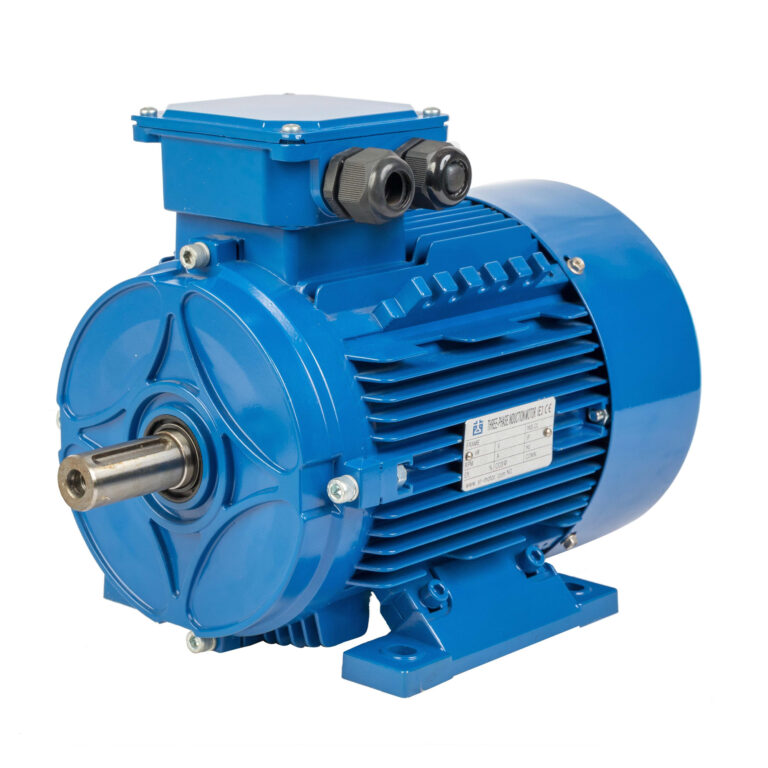
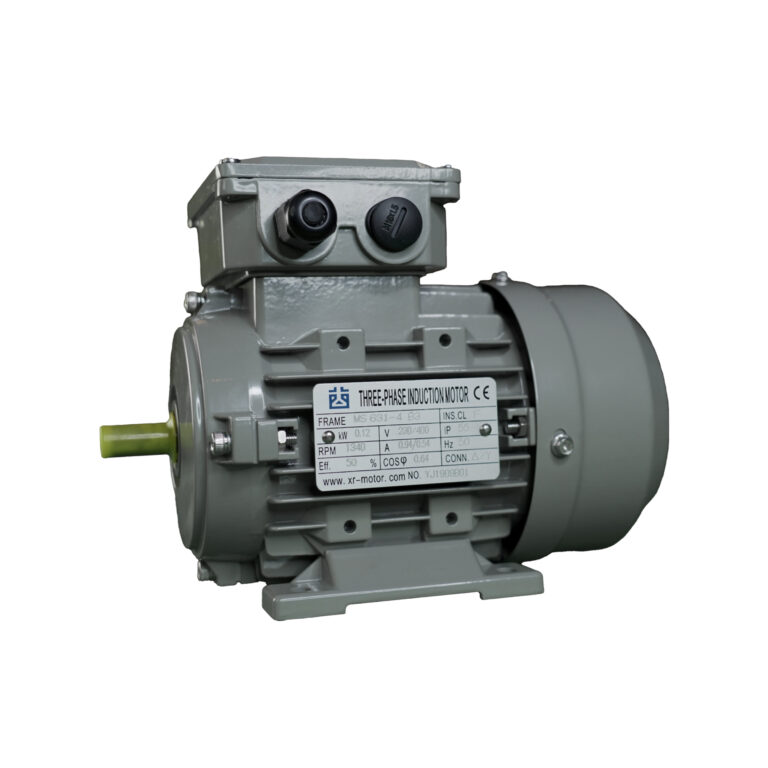
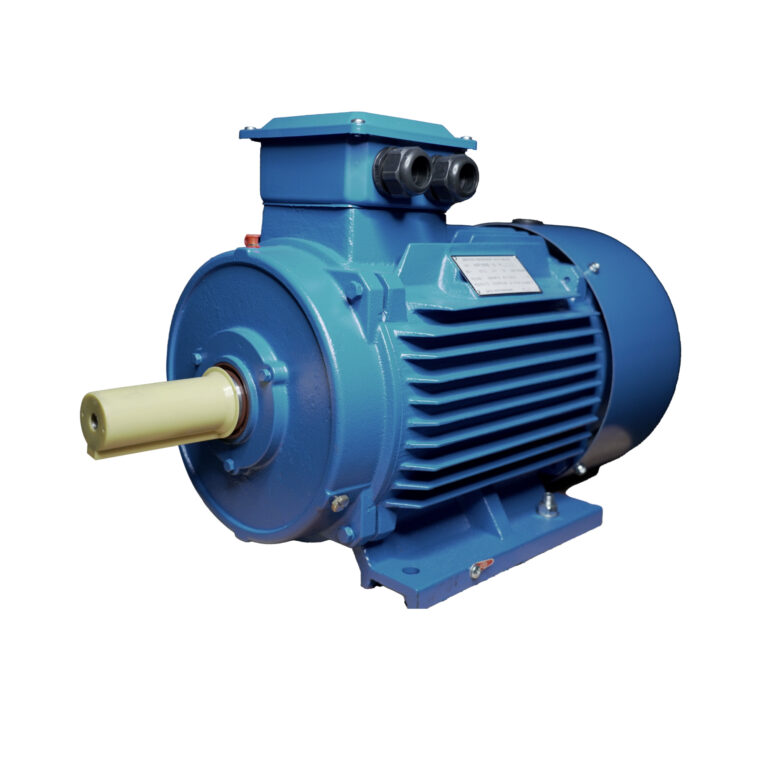
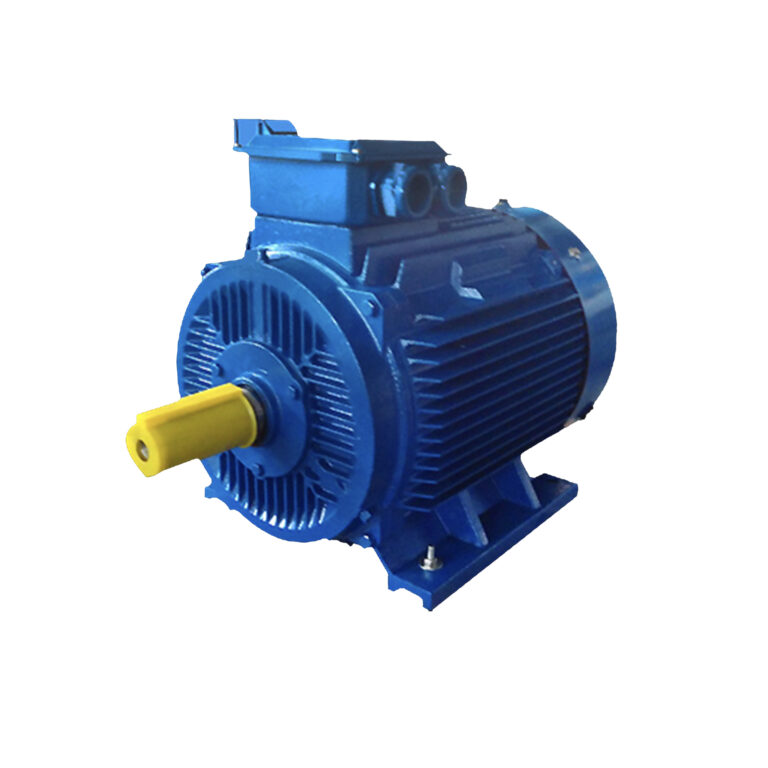
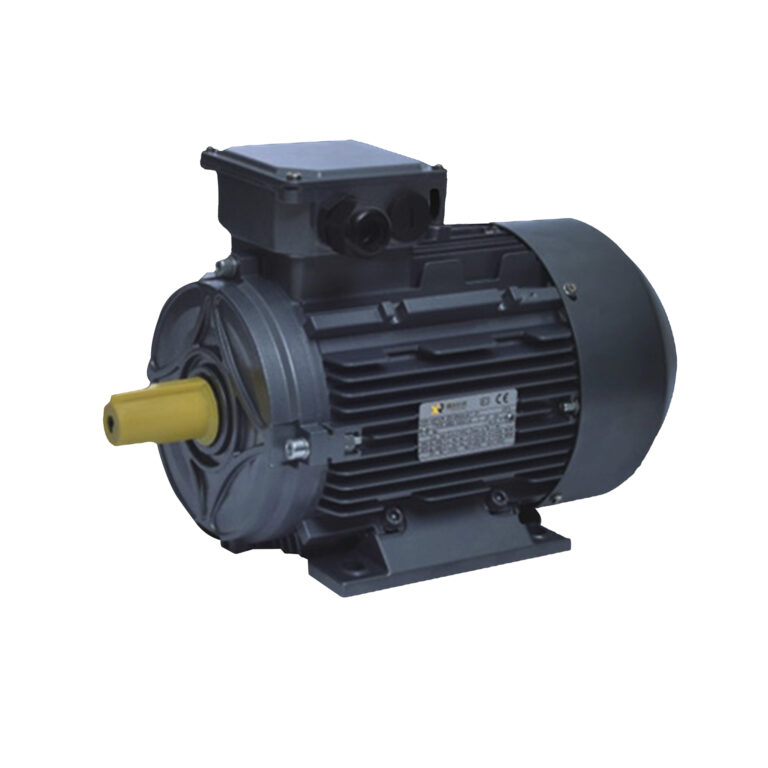
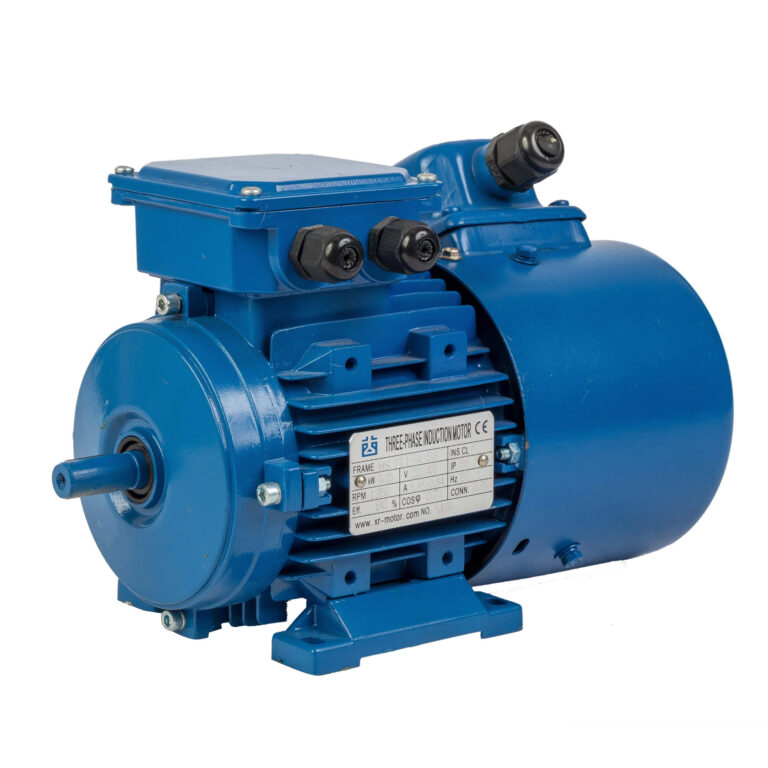
Industrial Compressor Motor Selection Guide
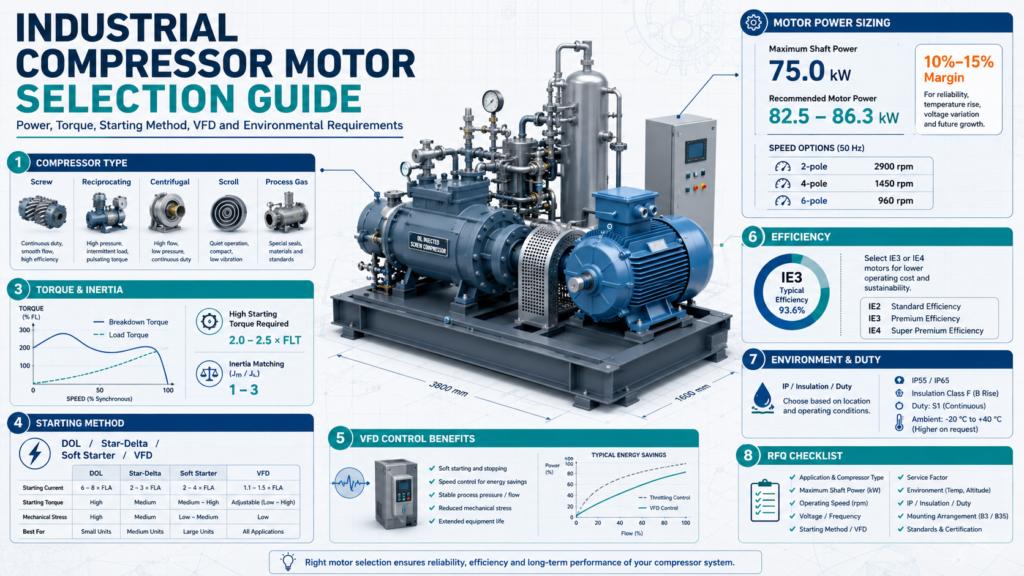
Selecting an industrial compressor motor begins with the compressor’s maximum shaft-power and torque requirements, not simply the nearest standard kW rating. Compressor type, gas conditions, transmission losses, starting method, speed control, electrical supply, and installation environment must all be considered.
An undersized motor may struggle to accelerate the compressor or overheat at full load. Excessive oversizing can also create problems, including higher purchase cost, poor light-load efficiency, and a narrower useful VFD control range. DAYOU MOTOR therefore recommends evaluating the complete operating envelope before confirming motor power.
Different Compressor Types Create Different Motor Loads
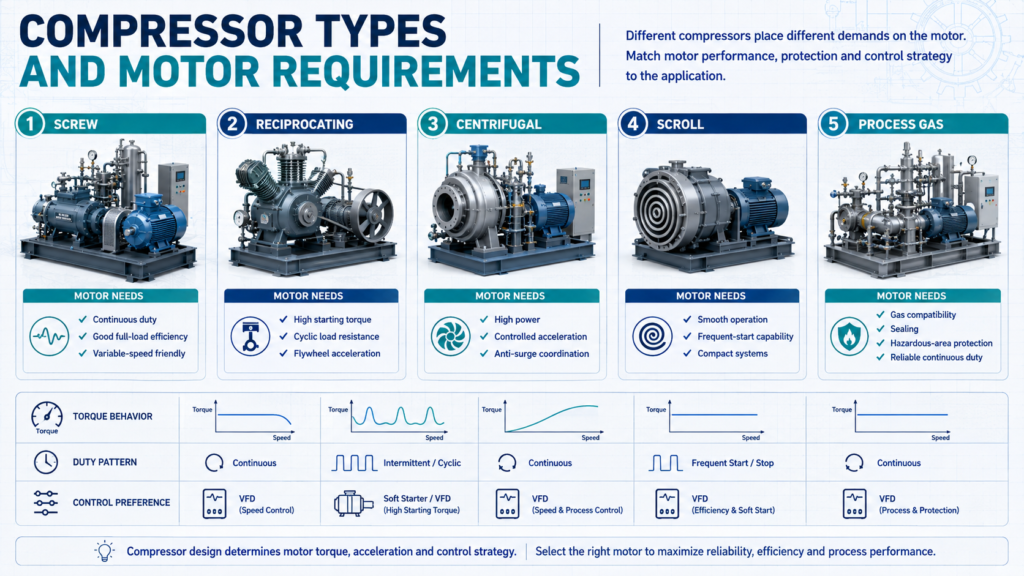
The compressor design determines how the motor starts, accelerates, and responds to changes in demand.
Compressor type | Important motor requirements |
Screw | Continuous-duty capability, good full-load efficiency, and suitable cooling during variable-speed operation |
Reciprocating | High starting torque, resistance to cyclic loading, and enough acceleration torque for the flywheel |
Centrifugal | High power, controlled acceleration, speed coordination, and integration with the anti-surge system |
Scroll | Smooth operation, frequent-start capability, and compatibility with the selected speed-control method |
Process gas | Gas compatibility, sealing, hazardous-area protection, and reliable continuous operation |
For process-gas applications, pressure and flow are not enough. Gas composition, molecular weight, compressibility, inlet temperature, and inlet pressure can all affect absorbed power.
Size the Motor from Maximum Shaft Power
Use the compressor manufacturer’s performance curve or calculation sheet whenever possible. Review the complete operating range, including maximum discharge pressure, loading and unloading conditions, gas variation, and all permitted inlet conditions.
Do not automatically assume that the highest inlet temperature creates the highest power demand. Gas density changes with inlet temperature and pressure, so the compressor supplier should identify the actual worst-case point.
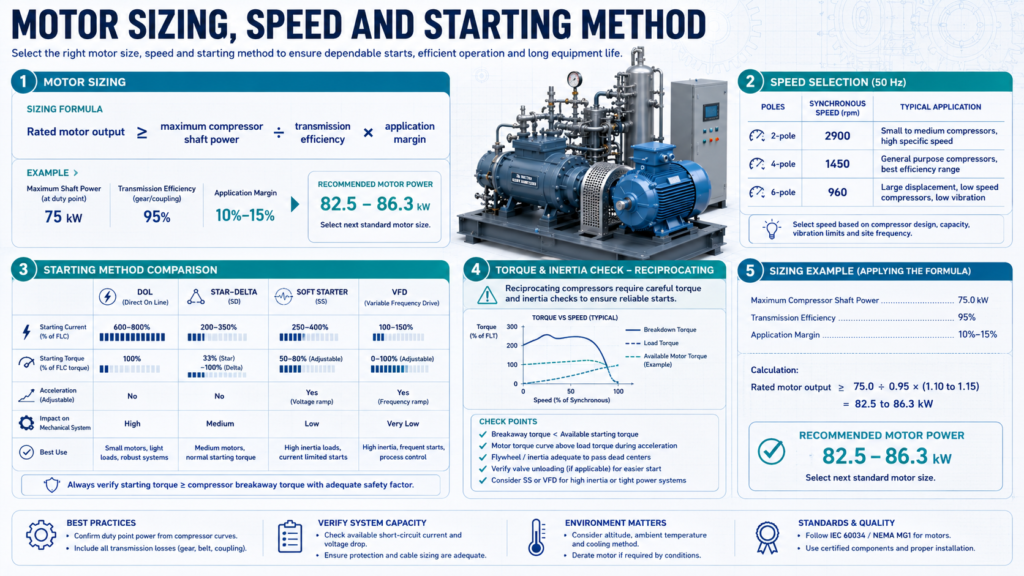
A practical sizing relationship is:
Rated motor output ≥ maximum compressor shaft power ÷ transmission efficiency × application margin
Direct-coupled systems generally have low transmission losses. Belt drives, gearboxes, and other mechanical components require additional allowance based on their efficiency.
The right compressor motor should cover the maximum realistic demand with a suitable engineering margin. Around 10%–15% may work for some stable, continuous applications, but fluctuating gas conditions, frequent loading cycles, uncertain process demand, or high starting inertia may require a different margin.
Speed, Torque, and Inertia Must Be Checked Together
The rated motor speed must match the compressor design speed or the selected transmission ratio. Typical full-load speeds at 50 Hz are approximately:
- 2-pole: 2,900 rpm
- 4-pole: 1,450 rpm
- 6-pole: 960 rpm
Actual speed varies with motor design and load, so use the rated nameplate speed when calculating pulley or gearbox ratios.
Reciprocating compressors need careful starting-torque and acceleration checks because their flywheels, couplings, and cyclic compression forces can create a demanding start. Centrifugal machines require coordination between acceleration time, critical-speed regions, lubrication, and anti-surge control.
Select a Starting Method the Power System Can Support
Direct-on-line starting is simple and economical, but it creates high starting current. Confirm that the electrical network can tolerate the voltage drop and that protective devices will not trip during acceleration.
Star-delta starting reduces current, but it also reduces available starting torque. It may be unsuitable when the compressor starts loaded or has high inertia.
A soft starter provides smoother acceleration and reduces mechanical shock without offering continuous speed control. It is often useful for larger fixed-speed systems.
A VFD provides controlled starting and variable-speed operation. A three phase compressor motor for Southeast Asian factories should be specified with the correct local voltage, frequency, inverter duty, and expected speed range.
Variable Speed Is Useful When Demand Changes
Screw compressors often work well with variable-speed control because their output can follow changing air demand. However, a VFD is not automatically the most efficient choice for every installation. A correctly sized fixed-speed machine may perform well when demand remains stable near full load.
CAGI notes that many compressed-air applications can benefit from variable speed, while proper sizing and analysis of the electrical supply remain important.
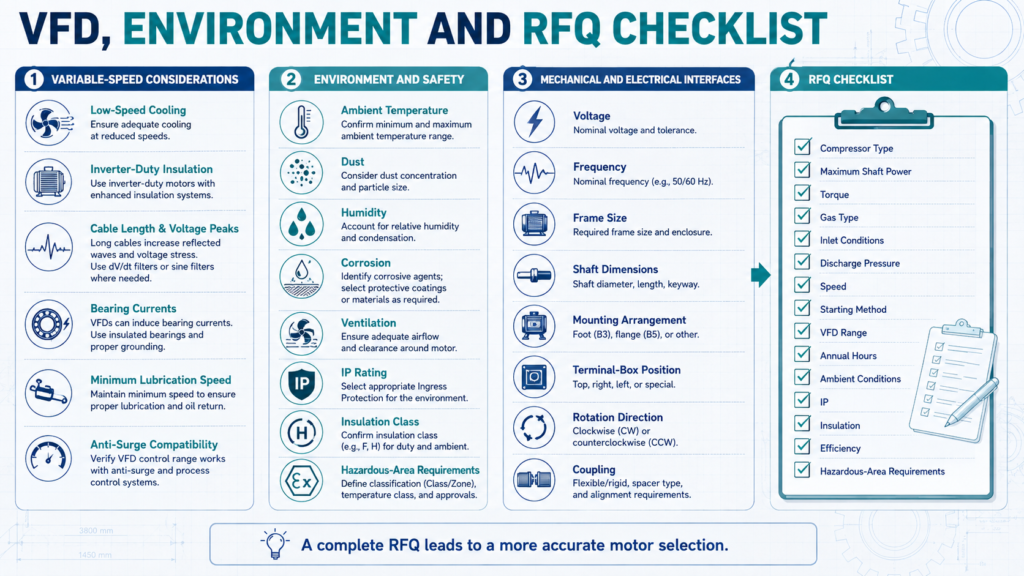
Variable-frequency operation also requires attention to:
- Cooling at low speed
- Inverter-resistant insulation
- Cable length and voltage peaks
- Bearing currents on larger machines
- Minimum lubrication and cooling speed
- Mechanical resonance
- Compressor control-system compatibility
Centrifugal machines must remain above their permitted minimum stable speed and coordinate with the anti-surge system.
Efficiency Should Be Evaluated Over the Duty Cycle
Compressors that operate continuously consume substantial energy over their service life. A higher-efficiency motor may cost more initially, but the difference can often be recovered through lower electricity consumption.
An IE3 compressor motor for European OEMs may be a practical baseline, although the required efficiency class depends on motor scope, local regulations, power rating, and application. IEC 60034-30-1:2025 defines IE efficiency classes for qualifying line-operated AC motors within its stated boundaries.
Efficiency class describes the motor, not the complete compression system. Compressor efficiency, pressure setting, air leaks, unloading time, cooling, and control strategy can have an even larger effect on total energy consumption.
Environment and Safety Requirements Affect the Design
The installation site should determine enclosure protection, insulation, cooling, materials, and surface treatment. Confirm ambient temperature, altitude, humidity, dust, corrosion, ventilation, and outdoor exposure.
A compressor motor supplier for Middle East projects should consider high ambient temperature, dust accumulation, cooling-air availability, and voltage conditions. Coastal or chemical sites may require enhanced coatings, anti-condensation heaters, and corrosion-resistant hardware.
Where flammable gas, vapor, or combustible dust may be present, the motor and associated electrical equipment must match the hazardous-area classification. The correct protection concept, gas group, dust group, temperature class, and certification should be established by qualified project personnel.
Mechanical and Electrical Interfaces Need Written Confirmation
Before ordering, verify voltage, frequency, mounting arrangement, frame size, shaft dimensions, rotation direction, coupling, belt load, and terminal-box position.
Buyers sourcing a motor for air compressor systems in South America should also confirm local supply voltage, frequency, import documentation, and spare-parts availability. An electric motor for compressor manufacturers in North America may require different nameplate, efficiency, safety, and dimensional requirements from an IEC-based project.
Mechanical drawings should be approved before production, especially when replacing an existing motor or connecting directly to a gearbox.
A Complete RFQ Produces a More Accurate Selection
Provide the following information to the motor supplier:
- Compressor type, model, and performance data
- Maximum shaft power and torque
- Gas type and inlet conditions
- Rated and maximum discharge pressure
- Target speed and transmission method
- Load and unload sequence
- Starting method and acceleration time
- VFD model and speed range
- Voltage, frequency, and available starting capacity
- Duty cycle, annual hours, and starts per hour
- Ambient temperature, altitude, and site conditions
- IP, insulation, efficiency, and hazardous-area requirements
- Frame, shaft, flange, coupling, and rotation details
DAYOU MOTOR uses this information to review capacity, starting performance, thermal behavior, inverter compatibility, and mechanical fit before production.
Frequently Asked Questions
Is a 10%–15% power margin always sufficient?
No. It may be suitable for some stable applications, but gas conditions, transmission losses, loading cycles, inertia, ambient temperature, and process uncertainty can change the required margin.
Is a VFD always better than a soft starter?
No. A VFD is useful when speed control is needed, while a soft starter may be more economical for a fixed-speed machine that only needs controlled acceleration.
Can I replace a motor using only the kW rating?
No. Speed, torque, inertia, voltage, mounting, shaft dimensions, starting method, duty cycle, and environmental requirements must also match.
The Worst-Case Operating Point Should Lead the Decision
The best compressor motor is sized from the highest realistic shaft-power demand, checked for starting torque and inertia, and matched to the site’s electrical and environmental conditions.
DAYOU MOTOR supports compressor manufacturers, distributors, and industrial users with application-based selection for stable starting, efficient operation, and reliable long-term service.